
Which CPA Australia subject has the highest failure rate among the compulsory subjects? And is it the one everyone warns you about?
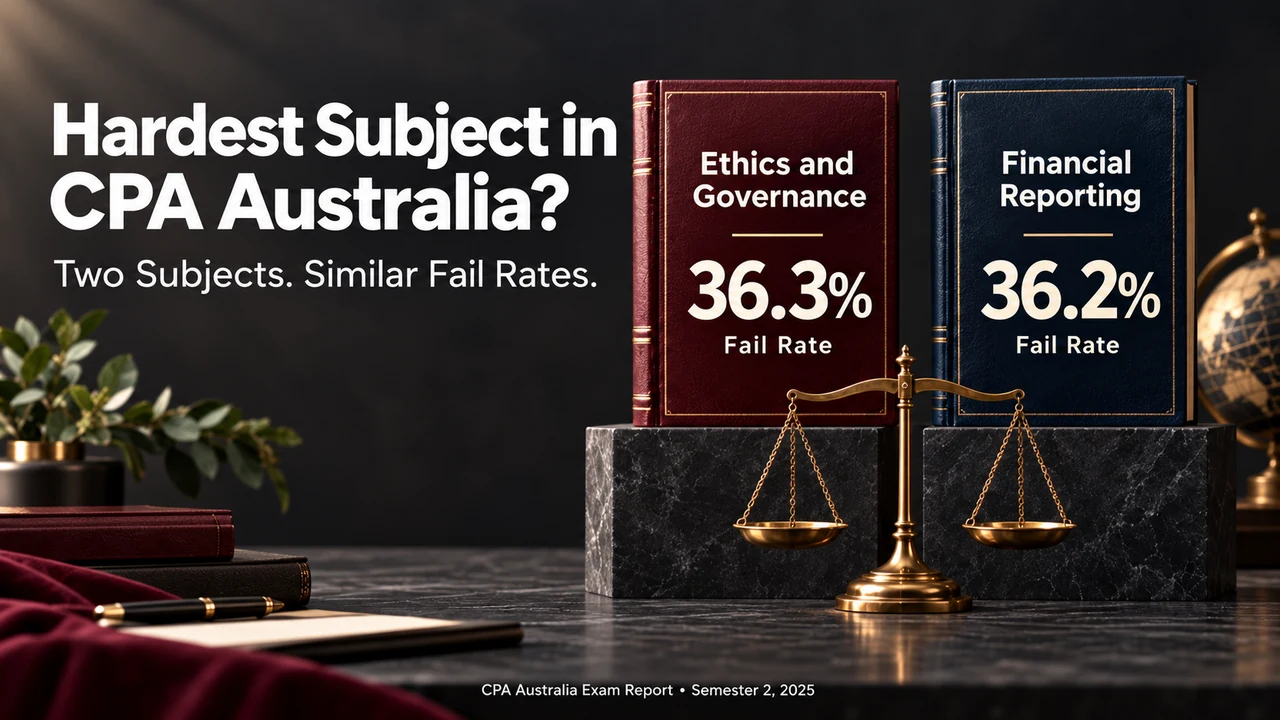
It is effectively a tie, and not the pair you might expect. In Semester 2 2025, 36.3% of Ethics and Governance candidates failed, against 36.2% in Financial Reporting, the subject most candidates warn about (CPA Program Exam Report, Semester 2 2025).
The hardest subject in CPA Australia therefore depends on whether you mean the compulsory subjects or every subject in the programme.
- 19,508 exams were delivered in October 2025.
- In that sitting, more than one in three candidates failed two of the compulsory subjects.
- In the other two, fewer than three in ten failed.
- Among the non-local electives, 38.4% of Australia Taxation – Advanced candidates failed.
- The pass mark is a scaled score of 540 (Singapore Taxation reports a grade range instead). There is no quota.
Fail rates also reflect who sits a subject and when, as well as the content. The useful question is which subject will be hardest for you, and in which semester.
CPA Australia’s six subjects at a glance
The CPA Program has four compulsory subjects and two electives. Each runs for a semester and ends in an exam (CPA Australia, Subjects and course guide).
Compulsory
- Ethics and Governance
- Strategic Management Accounting
- Financial Reporting
- Global Strategy and Leadership
Electives (choose two): Advanced Audit and Assurance, Contemporary Business Issues, Financial Risk Management, Digital Finance, Australia Taxation and Australia Taxation – Advanced. Local taxation variants exist for some markets.
CPA Australia pass and failure rates by subject
| Subject | Type | Fail rate | Pass rate* |
|---|---|---|---|
| Ethics and Governance | Compulsory | 36.3% | 63.7% |
| Financial Reporting | Compulsory | 36.2% | 63.8% |
| Strategic Management Accounting | Compulsory | 27.5% | 72.5% |
| Global Strategy and Leadership | Compulsory | 23.4% | 76.6% |
| Australia Taxation – Advanced | Elective | 38.4% | 61.6% |
| Australia Taxation | Elective | 25.4% | 74.6% |
| Contemporary Business Issues | Elective | 23.6% | 76.4% |
| Advanced Audit and Assurance | Elective | 23.0% | 77.0% |
| Digital Finance | Elective | 21.1% | 78.9% |
| Financial Risk Management | Elective | 20.8% | 79.2% |
| Singapore Taxation | Local taxation elective | 49.0% | 51.0% |
“Passed” combines Pass, Credit, Distinction and High Distinction (100% minus the fail rate). Singapore Taxation is a local-variant subject and the only closed-book CPA Program exam, so read it separately. The report gives no subject-level candidate counts, so small gaps between subjects should be read with care.
A passing standard, not a failure quota
It is a standard, not a curve. The pass mark is a scaled score of 540 on a 100 to 900 scale, equated across exam versions. CPA Australia says it does not fail a set percentage of candidates, and that if every candidate reached the standard, everyone would pass (Understanding your exam results). Singapore Taxation is the exception: its results come as a grade range.
So when 36% fail, 36% fell short of the standard in that sitting. Nobody is filling a quota.
Why Financial Reporting needs protected study time
Business combinations and group accounting carry 24% of the exam. Income taxes carry 18%. Both are calculation-heavy, and one early error runs through the whole answer (CPA Australia, Financial Reporting).
The extended-response section adds worksheet items, where you enter figures into a structured worksheet (Exam FAQs). A consolidation with intragroup eliminations, non-controlling interests and deferred tax punishes a slow start. Practise complete problems under timed conditions.
Open book helps when you are checking a detail. It helps much less when you are looking up the method.
Ind AS is based on and substantially converged with IFRS, so Ind AS 103 and Ind AS 110 will feel familiar (IFRS Foundation). But it contains carve-outs and carve-ins, and the exam tests IFRS as issued. Do not assume an Indian modification applies to an IFRS question. The exam also rewards written judgement alongside correct journal entries.
If you have never built full group accounts, give this subject your most protected semester.
Why Ethics and Governance deserves equal attention
On the surface it looks like the gentlest compulsory subject: few calculations and familiar themes. That is exactly why it catches people. In Semester 2 2025, 36.3% of candidates failed it, almost the same share as Financial Reporting.
- It is often the first exam. CPA Australia notes that many candidates start here (CPA Program FAQs). They meet the open-book, typed-response format for the first time. This is our reading. CPA Australia publishes no data that proves it.
- Half the exam is governance. Governance concepts and governance in practice carry 25% each (CPA Australia, Ethics and Governance). It is reading-heavy, and technical accountants underestimate it.
- Writing is a skill of its own. Identify the issue, apply the principle, reach a defensible conclusion. Knowing a definition is different from applying it to a scenario in the time available.
Treat it as a full subject, not a warm-up.
Indian Chartered Accountants using the ICAI pathway
The MRA route applies if:
- You are an eligible ICAI member: in good standing, not admitted through another pathway, with the ICAI exams and practical experience complete.
- You hold a university degree at least equivalent to an Australian bachelor degree, or have at least five years’ professional accounting experience.
- You are admitted as an Associate of CPA Australia and keep your ICAI membership.
- You then complete Global Strategy and Leadership and the online Better Practice in Governance and Accountability course (CPA Australia, ICAI pathway).
For a CA on this route, Global Strategy and Leadership is the only exam, so it is the hardest by definition. The content is rarely the problem. The case-based multiple choice and the strategic writing are unlike the ICAI exams. See our guide to the ICAI and CPA Australia MRA.
Strategic Management Accounting and Global Strategy and Leadership
Strategic Management Accounting (27.5% fail) is calculation plus judgement. Performance management carries 23% and planning, budgeting and forecasting 22% (CPA Australia). The test is turning a number into a recommendation.
Global Strategy and Leadership (23.4% fail) is the capstone (CPA Australia). Its lower fail rate needs context. Most candidates arrive having sat three CPA exams. MRA candidates are the exception, as it is their only exam. A lower rate does not mean you can prepare casually.
Which elective needs the most preparation?
Australia Taxation – Advanced. 38.4% of candidates failed it in Semester 2 2025, the highest among the non-local electives. CPA Australia describes it as requiring prior undergraduate-level learning in Australian taxation (CPA Australia).
Australia Taxation had a 25.4% fail rate. The four non-tax electives ranged from 20.8% to 23.6%.
If you are in India:
- Check your assessment outcome from CPA Australia first. If tax study is required for you, you will sit an Australian tax subject whatever its fail rate. Australian income tax law will be new, so plan extra time.
- With a free choice, pick for career and existing knowledge.
- Avoid Australia Taxation – Advanced unless you have the Australian tax grounding it assumes.
Which subject is hardest for you?
- Indian CA on the MRA: your only exam is Global Strategy and Leadership. Prepare for its format.
- B.Com or M.Com graduate: Financial Reporting is usually the biggest step up. Ethics and Governance will test your writing.
- ACCA member or affiliate: do not assume automatic CPA Australia exemptions. See ACCA exemptions in CPA Australia.
- FP&A professional: Strategic Management Accounting will feel familiar. Financial Reporting is the one to plan around.
- Audit professional: Advanced Audit and Assurance will feel familiar. Plan your time around reporting and governance.
A practical study order
On the standard pathway, CPA Australia sets one rule on order: you cannot enrol in Global Strategy and Leadership until the other three compulsory subjects are complete. There is no other set order. The rest is our planning suggestion.
- Ethics and Governance. It teaches the exam format.
- Strategic Management Accounting. It builds worksheet and written-analysis skills.
- Financial Reporting. Sit it no later than third, so a resit does not collide with your capstone.
- Global Strategy and Leadership.
- Your two electives. Place them by your assessment, background and workload. They need not follow the capstone.
CPA Australia recommends 10–15 hours a week per subject and one subject per semester, with a maximum of three. A resit costs another semester and another enrolment fee. The 2026 rates are AUD 1,416 early bird or AUD 1,597 standard, and 2027 fees may differ (fee schedule). Our guide to CPA Australia fees from India shows how resits change the total, and course duration shows realistic timelines.
Examination format and published windows
- Length: 3 hours 15 minutes of exam time.
- Questions: multiple choice and typed extended response. Global Strategy and Leadership adds case-based multiple choice. Strategic Management Accounting and Financial Reporting add worksheet items.
- Open book: yes, except Singapore Taxation. No pen and paper. A whiteboard is provided.
- Where: Pearson VUE test centres, with online-proctored appointments where available.
Semester 1 2027, the next window:
- Enrolment opens 30 November 2026.
- Early bird closes 13 January 2027.
- Enrolment closes 2 February 2027, a day after the semester starts.
- Exam scheduling closes 9 February 2027.
- Exams run 12–27 April 2027.
Dates are subject to change. Confirm on CPA Australia’s important dates page.
How GLOBALFTI can help
GLOBALFTI prepares candidates for CPA Australia, including dedicated Global Strategy and Leadership preparation for Indian CAs on the MRA pathway. See what the CPA Australia course includes, or read whether you can do CPA Australia from India.
Sit the subject that a third of candidates fail when you have the hours to give it. The fail rate is an average. The hours are yours.
Frequently asked questions
Which is the hardest subject in CPA Australia?
By CPA Australia’s own exam data, Ethics and Governance (36.3% fail) and Financial Reporting (36.2% fail) were the hardest compulsory subjects in Semester 2 2025, effectively a tie. Among the non-local electives, Australia Taxation – Advanced had the highest fail rate, at 38.4%.
Which CPA Australia subject has the highest pass rate?
Among the compulsory subjects, Global Strategy and Leadership, with 76.6% of candidates passing in Semester 2 2025. Among the electives, Financial Risk Management (79.2%) and Digital Finance (78.9%) had the highest pass rates.
What is the pass mark for CPA Australia exams?
CPA Australia reports results as a scaled score between 100 and 900. The passing scaled score is 540 for every CPA Program exam except Singapore Taxation, which reports a grade range instead.
Are CPA Australia exams open book?
Yes. All CPA Program exams are open book except Singapore Taxation. You can bring your study guide and printed notes, but pen and paper are not allowed; you use a whiteboard instead.
How long is a CPA Australia exam and what is the format?
Each CPA Program exam gives you 3 hours 15 minutes of exam time. Exams combine multiple-choice and extended-response questions. Strategic Management Accounting and Financial Reporting include numerical worksheet items, and Global Strategy and Leadership includes multiple-choice questions based on short case studies.
When can I sit CPA Australia exams?
CPA Program exams run twice a year, in an April window (Semester 1) and an October window (Semester 2), each about two weeks long. Enrolment closes a day after the semester starts, and exam scheduling closes about a week after that, so check CPA Australia’s important dates page for current deadlines.
Does CPA Australia fail a fixed percentage of candidates?
No. CPA Australia sets a passing standard rather than a quota. Every candidate who reaches the passing standard passes, however many candidates that is.
I am an Indian Chartered Accountant. Which CPA Australia subject do I need to pass?
Under the Mutual Recognition Agreement between CPA Australia and ICAI, an eligible ICAI member admitted as an Associate completes one CPA Program subject, Global Strategy and Leadership, plus the online Better Practice in Governance and Accountability course, to advance to CPA status.
How many hours should I study for each CPA Australia subject?
CPA Australia recommends 10 to 15 hours of study per subject per week across the semester. It recommends one subject per semester, with a maximum of three.
Source for the fail and pass rates: CPA Australia, CPA Program Exam Report, Semester 2 2025. We update this page when newer reports are verified.