
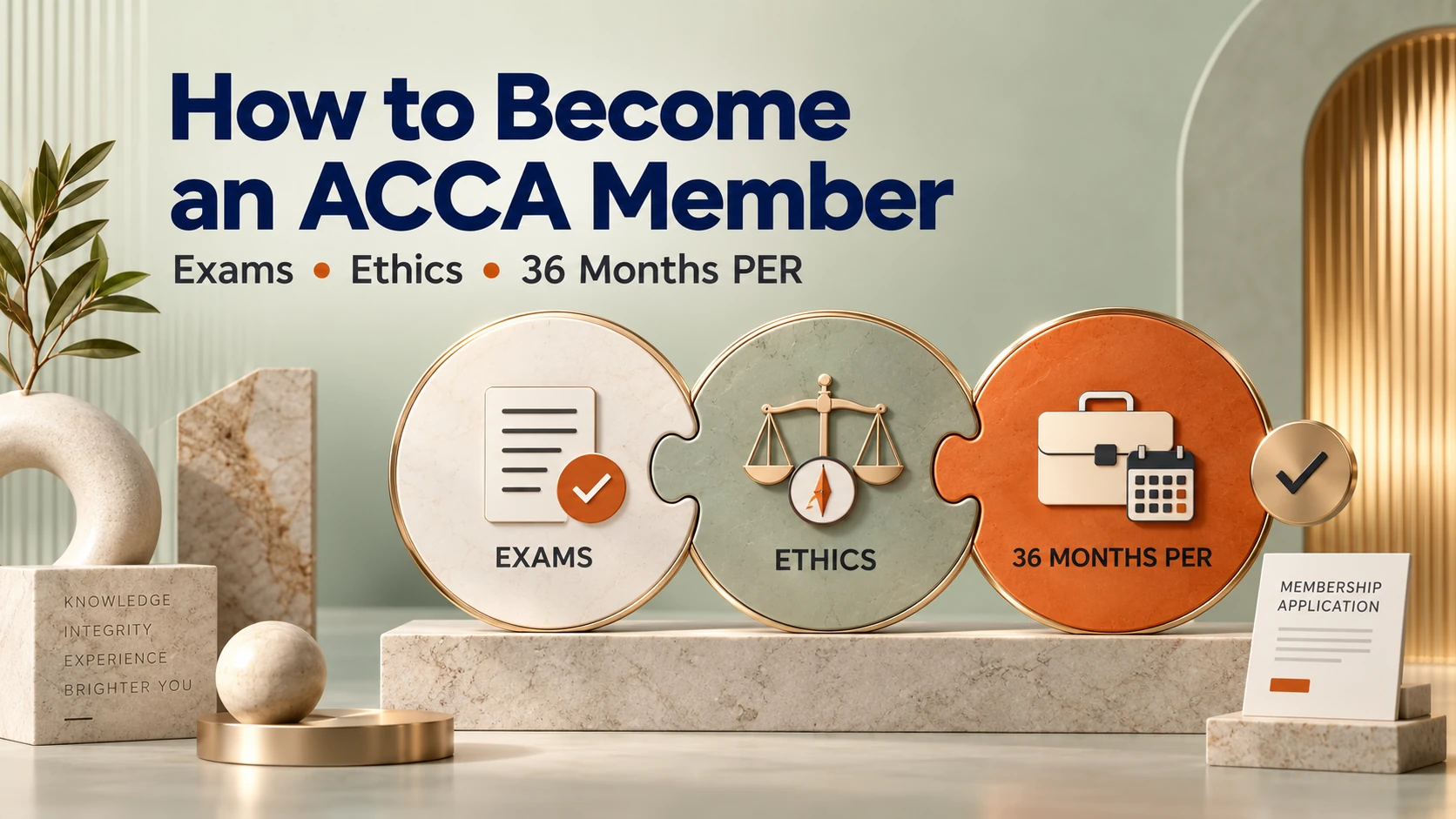
Becoming an ACCA member opens the door to a globally recognised accounting qualification – one that can meaningfully change your options in public accounting, corporate finance, and beyond. Whether you’re starting straight after Class 12 or building on an existing degree, the ACCA programme runs on a structured path: exams, practical experience, and an ethics module. How long that path takes depends heavily on your prior qualifications and the exemptions they unlock, which is why the ACCA course duration varies so widely between candidates.
Who Is an ACCA Member?
An ACCA member is a professional who has completed all required ACCA exams, gained the required practical experience, and met ACCA’s ethical standards. ACCA members are recognised globally, which opens career paths across public practice, industry, and financial services.
Eligibility Criteria
General requirements: ACCA doesn’t gate entry by age or educational background, but a solid grounding in maths, accounting, and business is expected to succeed in the exams.
Educational qualifications: Most students need two A-levels and three GCSEs, or the equivalent – Class 12 in India qualifies you for the Foundation Diploma route.
| Education Level | Eligibility |
|---|---|
| Class 12 | Eligible for the Foundation Diploma |
| BCom/MCom | Exempt from certain Knowledge Level exams |
| CA (Chartered Accountant) | Exempt from 9 out of 13 exams |
| CA IPCC | Exempt from 5 exams, including Audit and Taxation |
Getting Started
- Register as a student on the ACCA official website
- Submit educational certificates and details of any prior qualifications that may carry exemptions
- Consult an ACCA-accredited institute to confirm your exemption eligibility before registering – this step catches errors that are expensive to correct after you’ve already registered
Pathways Into ACCA
Foundation in Accountancy (FIA) – for candidates with no formal business qualifications, building essential skills before the core ACCA route.
ACCA Qualification (the core route for most students), in three levels:
- Applied Knowledge – three exams: Business and Technology, Financial Accounting, Management Accounting
- Applied Skills – six exams, including Taxation, Corporate and Business Law, and Performance Management
- Strategic Professional – four advanced exams, including options like Advanced Financial Management, plus a required ethics module
Exemptions in Full
| Qualification | Exemptions |
|---|---|
| Class 12 | Exempt from the Foundation Diploma |
| BCom/MCom | Exempt from Business Technology, Management Accounting, Financial Accounting, and Corporate Law |
| CA (Chartered Accountant) | Exempt from all Knowledge and Skills Level exams (9 papers) |
| CA IPCC | Exempt from 5 exams, including Audit and Taxation |
The gap between a BCom exemption and a full CA exemption is substantial – if you’re weighing whether to sit ACCA exams before or after finishing CA, run your specific transcript past an ACCA-accredited institute rather than relying on this table alone; exemption rules are assessed case by case.
How to Become an ACCA Member: Step by Step
1. Pass all ACCA exams. Thirteen exams total across Applied Knowledge, Applied Skills, and Strategic Professional – though most candidates complete far fewer once exemptions are applied. The four Strategic Professional exams are mandatory for everyone, regardless of exemptions.
2. Complete the Ethics and Professional Skills Module. A mandatory 20-hour, self-paced online module covering professional ethics, communication, and leadership.
3. Complete the Practical Experience Requirement (PER).
- 36 months of relevant work experience in an accountancy or finance role meeting ACCA’s standards
- Nine Performance Objectives demonstrating competency across key professional areas
- Verification and sign-off from a supervisor who can confirm your work
GLOBALFTI, as an ACCA Platinum Approved Learning Partner in India, emphasises gaining this practical experience at an ACCA-approved employer or a CA firm. GLOBALFTI doesn’t offer direct job placement for PER specifically, but its coaching and guidance are structured to make sure students are well-prepared to pursue the right experience.
Applying for Membership
Once exams, the Ethics Module, and PER are complete, apply via the myACCA portal:
- Log into myACCA and go to “My Qualification”
- Click “Apply for Membership” and complete the required fields
- Confirm all qualifications are recorded as complete
- Review the checklist – contact details, any legal disclosures, and public-practice documentation if relevant
- Complete employment and qualification information, or skip where optional
- Set your information-sharing preferences with other ACCA members
- Read and confirm the declaration, including the admission fee
- Submit and receive confirmation
Renewal and CPD
- Annual membership renewal – a fee applies to retain active status (confirm the current figure directly with ACCA before quoting it, as it’s revised periodically)
- CPD (Continuing Professional Development) – 40 units annually, at least 21 from structured learning, through workshops, courses, and relevant reading
Benefits of ACCA Membership, by Region
In India: MNCs actively seek ACCA professionals for accounting, finance, and audit roles – Bangalore in particular has a growing number of ACCA jobs in Bangalore as global firms expand their local presence. Total ACCA costs in India typically run between ₹3.5 lakh and ₹5 lakh, assuming first-attempt passes — this varies with the number of exemptions you hold and the coaching institute you choose.
In the UK and Europe: Salaries for ACCA members in the UK typically range from £30,000 to £50,000 depending on experience, with strong mobility into other international roles.
In the Middle East: Tax-free income in the UAE, high demand in banking, consulting, and oil and gas, and a large expat professional network.
Common Mistakes to Avoid
- Delaying PER – start gaining relevant work experience early rather than scrambling near the end
- Not completing the Ethics Module promptly – finish it soon after your exams, not years later
- Not documenting work experience – keep records as you go, for straightforward verification later
- Missing application deadlines – check the myACCA portal regularly
Frequently Asked Questions
How long does it take to finish the ACCA qualification?
On average, 3–4 years including exams and the 36-month PER, though this varies with prior qualifications and exemptions.
Do I have to complete the PER?
Yes – 36 months of relevant experience, which can be gained before, during, or after your exams, logged through ACCA’s MyExperience tool.
Can I study for ACCA while working full-time?
Yes – ACCA offers part-time classes, online courses, and self-paced learning built for exactly this.
How do I apply for ACCA membership?
After passing exams, completing the Ethics Module, and fulfilling the PER, apply through the ACCA website.
How do I register for ACCA?
Register on the ACCA website, submit academic certificates, and check for exemptions based on prior qualifications – an ACCA-accredited institute can confirm exemption eligibility before you register.
Want expert guidance through this process?
GLOBALFTI offers coaching, personalised learning plans, and flexible study options to help you move through ACCA exams and toward membership efficiently.